How to climb from Bronze to Unreal in Fortnite Reload without losing your mind
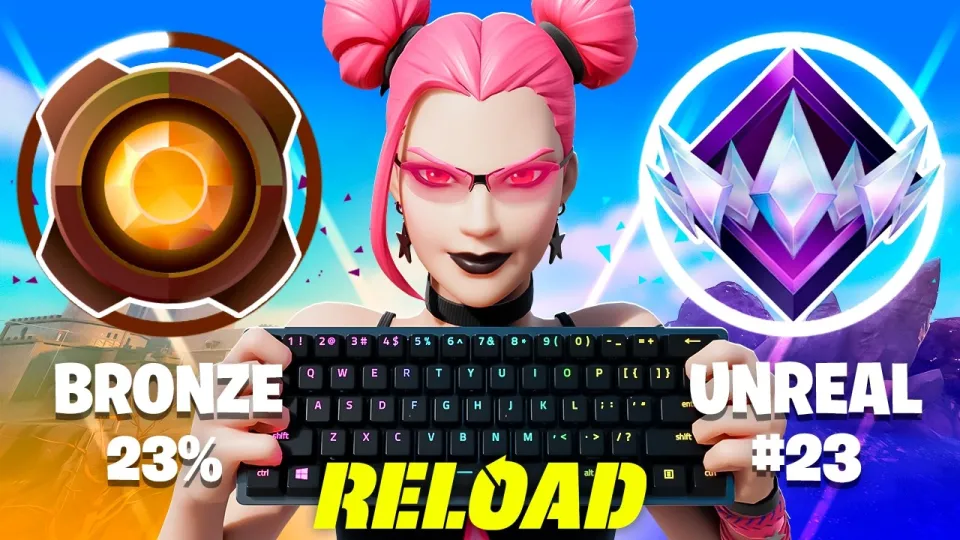
Video: BRONZE To UNREAL Ranked Speedrun In Fortnite Reload!
Want articles like this for your own video to promote it on YouTube and Google? Order them through the Telegram bot @sat_sit_bot. It writes articles around your video, embeds the video and publishes them on popular niche websites (no ads). Free trial — 50 articles.
· based on the channel HaloBT
Key takeaways
- Fortnite Reload is a faster ranked mode: shorter matches, faster respawns and more fights per hour than standard Battle Royale.
- The climb runs Bronze, Silver, Gold, Platinum, Diamond, Elite, Champion and finally Unreal — the top tier has no fixed ceiling.
- Gold is the usual wall: players there fight constantly but still make basic rotation and healing mistakes.
- Solo queue and duo fills demand different plans — in fills you should set a clear drop and a shared rotation before the bus leaves.
- Volume beats perfection: more matches per session with a fixed plan climbs faster than a few 'perfect' games.
Fortnite Reload is the fastest way to turn raw mechanical skill into rank, because matches are short, respawns are frequent and every fight is a chance to gain placement points instead of losing a 25-minute game. To climb from Bronze to Unreal in Fortnite Reload you need three things: a repeatable early-game plan, a loadout that works in close-range chaos, and the discipline to stop fighting once the circle gets small. The route HaloBT takes in the Bronze to Unreal Ranked speedrun is built on exactly that logic, and the creator's practice maps are free to browse at HaloBT's Fortnite creator page.
What Fortnite Reload ranked actually rewards
Fortnite Reload rewards consistent eliminations and survival inside a compressed match, not slow loot-heavy play. The mode drops you into a smaller map with respawn mechanics, so the cost of a bad fight is lower than in standard ranked Battle Royale — but the cost of a bad rotation is still a lost game. Points come from placement and eliminations together, which means a player who takes three smart fights and dies in the top five usually out-earns a player who hides to the final circle with zero kills.
That changes the math of the climb. In a normal ranked season, a Bronze player might need dozens of careful matches to move up. In Reload, the same player can gain a full division in a single evening if the fights are deliberate. The mode also resets the mental load: you are never truly out of a match after one mistake, so hesitation costs more than aggression.
The rank ladder from Bronze to Unreal
The Fortnite ranked ladder runs through eight tiers: Bronze, Silver, Gold, Platinum, Diamond, Elite, Champion and Unreal. Bronze through Diamond are divided into three sub-divisions each, so the real number of steps is far bigger than eight. Unreal has no sub-divisions and no fixed point ceiling — it is a percentile-based top tier, which is why players talk about their Unreal placement number rather than a rank.
A few practical notes on the ladder:
- Early tiers (Bronze, Silver) forgive losses generously; you can climb with a positive kill-to-death ratio and average placement.
- Gold is where the point gain slows down and the lobby starts punishing solo overextension.
- Platinum and Diamond demand consistent endgame decisions, not just aim.
- Elite and Champion are where a single bad drop costs more than five good fights earn.
- Unreal is reached by accumulation, not by a single hot streak.
Drop spots and the first 90 seconds
The first fight of a Reload match decides the tempo of everything after it, so pick a landing spot you can leave from. The rule that works at every rank below Diamond: land where you can get a weapon, a shield item and a rotation exit within the first thirty seconds. Named locations with dense loot are tempting, but a Bronze or Silver player who lands in a crowded POI usually dies to a better mechanical player before finding a shotgun.
A workable pattern for the climb:
- Choose two landing spots and alternate between them for a whole session, so the terrain becomes muscle memory.
- Loot in a straight line toward the next circle, not in circles around a building.
- Take the first fight only if you have a close-range weapon and at least one shield.
- Leave every fight you did not choose — third parties in Reload arrive fast.
By Platinum, the same rule shifts: you start landing near contested areas on purpose, because the players you meet there are the ones you need to beat to gain points at that level.
Loadout priorities in a respawn-heavy mode
Fortnite Reload punishes slow weapons and rewards anything that wins a fight in under three seconds. The priority order for most of the climb is close-range first, mobility second, healing third, long-range last. A shotgun plus an SMG covers the majority of Reload fights, and a mobility item is what turns a losing fight into a rotation instead of a death.
Specific habits that separate climbing players from stuck ones:
- Carry at least two healing slots by mid-game; in Reload you will often fight twice in the same circle.
- Do not hold a sniper slot in Bronze or Silver — it slows your looting and rarely wins the fights that matter at that level.
- Swap weapons after every fight instead of reloading under pressure.
- Keep one build material stack topped up; the mode's faster pace means you build in shorter bursts.
Solo queue versus duo fills
Duo fills is the fastest climb for a player with decent mechanics and no regular partner, but only if you take control of the drop. Random teammates in fills follow whoever speaks first, so calling a landing spot and a rotation direction in the first ten seconds doubles your survival rate. If nobody responds, treat the match as a solo game with a witness and play your own plan.
Solo queue is slower but more predictable. The main risk is overextending in Gold, where lobbies are full of players with good aim and no patience. In solo, the winning pattern is two or three controlled fights early, then a rotation to a low-traffic edge of the circle, then one final fight. That is not glamorous, but it is how a player moves through Platinum without dropping divisions.
The Gold wall and how to break it
Gold is the rank where most climbs stall, and the reason is rarely aim. Players in Gold fight constantly but lose points on three repeatable mistakes: healing too late, rotating through open ground, and taking a fight with no exit. Fixing those three things is worth more than a week of aim training.
A short checklist for anyone stuck in Gold:
- Heal to full before you re-engage, even if the fight feels won.
- Rotate along terrain, not across fields, and start moving before the circle forces you.
- Never take a fight where your only escape is the direction the enemy is watching.
- Review one lost match per session and name the single decision that cost it.
- Play in blocks of five matches, then stop — tired Gold lobbies are where divisions disappear.
The mechanical side still matters, and the most efficient fix is isolated practice rather than more ranked games. Custom practice maps built for aim, editing and piece control let you compress hours of improvement into short sessions, which is exactly the gap players describe when their progress suddenly flattens after switching input or hitting a new rank.
Useful links
- HaloBT's Fortnite creator page with practice maps and game codes: https://www.fortnite.com/@MoreHaloBT
- Community Discord for lobbies and questions: https://discord.com/invite/halobt
- Live streams: https://www.twitch.tv/halobt
- Twitter updates: https://twitter.com/halobombtrooper
- Instagram: https://www.instagram.com/therealhalobt
Final thoughts on the Bronze to Unreal grind
The climb from Bronze to Unreal in Fortnite Reload is a volume game with a discipline filter: the players who move up are the ones who take the same good fight fifty times instead of chasing a highlight once. Fix your drop, fix your loadout, and stop losing points to late healing and open-ground rotations, and the divisions will move faster than you expect. The speedrun format works because it removes excuses — every match is short, every mistake is cheap, and every session is a chance to test one change. HaloBT's Bronze to Unreal run is a useful reference point for what that pace looks like in practice, and the creator's map library at HaloBT's Fortnite page is the place to start if your mechanics, not your decisions, are the bottleneck.
Source: BRONZE To UNREAL Ranked Speedrun In Fortnite Reload! · Markdown version
Questions & answers
How long does it take to go from Bronze to Unreal in Fortnite Reload?
There is no fixed number, because point gain depends on your placements and eliminations per match. A player with solid mechanics and a repeatable drop plan can move several divisions in a single long session, while a player splitting attention between modes usually needs weeks. The bottleneck is almost always decision-making in Gold and Platinum, not aim.
Is it better to climb in solo queue or duo fills?
Duo fills is faster if you take the lead on drop and rotation calls in the first seconds of the match, because random teammates follow the first clear voice. Solo queue is slower but more predictable and better for fixing your own habits. Many players alternate: fills for volume, solo for practice on specific weaknesses.
Why does my progress stall in Gold?
Gold lobbies are full of players with decent aim and poor patience, so fights happen constantly and points leak through small mistakes. The usual culprits are healing too late, rotating across open ground and taking fights with no escape route. Reviewing one lost match per session and naming the decisive mistake fixes more rank than extra aim training.
Do I need a practice map to reach Unreal?
Not strictly, but isolated mechanical practice is the most efficient way to fix a plateau, especially after switching input or hitting a new tier. Short sessions on aim, editing and piece-control maps compress improvement that would otherwise take dozens of ranked games. Creator-made practice maps in Fortnite are free to load and usually take minutes per session.